
The man who built a school
stone by stone
How Prof. N. Ananthachar turned a Basavanagudi vegetable cart and a class of three children into Acharya Patashala — the group of institutions that has educated Bengaluru for ninety years.
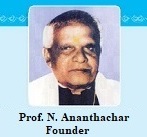
Prof. N. Ananthachar (5 September 1910 – 21 April 1976) was born into a Madhwa Brahmin family of modest means at Nyamagondlu, near Tumkur, and raised and educated in Mysore. The eldest of five children of Narasimha Murthy Acharya — a teacher well versed in Kannada and Sanskrit — and Tulasamma, he was a gifted student and sportsman who studied at Lakshmipuram Government School and D. Banumaiah's School before earning a Master of Arts from the University of Mysore around 1930.
A hard start in Bengaluru
In 1933, newly married to Narmada Bai, he came to Bengaluru in search of work, and the early years tested him. He gave private tuitions, tried his hand at contracting, and eventually opened a fruit-and-vegetable business at IV Cross Road, Basavanagudi — later the store "Acharya and Co." near Vidyarthi Bhavan. When neighbours asked why a man with two degrees was selling vegetables, he paid them no mind. It was in these years that he met Navaratna Rama Rao, a Mysore government official who would become a lifelong patron of his work.
He believed vidyadana — the giving of education — was the greatest gift of all, and that every child deserved a place to learn, whatever their means, gender or faith.
The school that began with three students
On 15 August 1935, Ananthachar opened the Acharya Pathashala Primary School on the first floor of the Basavanagudi Co-operative Society building, funding it in part by selling the family gold. Navaratna Rama Rao inaugurated it, and it opened with just three pupils. Within a year it had grown enough to win recognition from the government of the day. He taught in Kannada and began an Akshara Dasoha — a free-meal scheme — so that no child ever went hungry at school.
His belief in education for all was no slogan. He coached a Muslim student, Rashida Begum, to top marks when that was still uncommon, and later rearranged a Muslim teacher's timetable so he could offer his Friday prayers. Appointments, he insisted, were to be made on merit alone — on one occasion his own son was passed over for a principalship in favour of a better-qualified candidate.
Built stone by stone
The story of how the permanent building rose is the story of the man himself. The municipality granted a free site — on the condition that construction finish within a year, or forfeit the land. The ground was rocky and uneven; the loose stones once dismissed as useless went straight into the walls. And the money ran out, again and again.
Ananthachar did not wait for help — he became it. He laboured on the site himself, carrying stones from one end to the other, and went from house to house for donations, accepting the smallest gift without complaint. Some families gave doors, windows and zinc roofing sheets in place of cash; one supporter, Srinivasaiyya, donated 42 zinc sheets. A retired PWD officer, D. Krishna Rao, gave ₹1,000 that revived the work when it had stalled. The building committee's president, M. Rama Rao, arranged loans from the Bank of Mysore and, when one loan of ₹5,500 could not be repaid, quietly settled it from his own pocket; G. A. Acharya of Bengal Electricals lent sums that grew from ₹100 to ₹20,000. Piece by piece, gift by gift, the building rose.
One school becomes many
Over the next three decades, one school became many. A middle school followed in 1936–37, a high school and a girls' school in 1946, and in 1956 the Arts, Science and Commerce College — inaugurated by the poet Kuvempu, its recognition helped along by V. L. D'Souza, Vice-Chancellor of the University of Mysore. A Polytechnic came in 1958, among the first started under a central-government scheme, and later moved to the sprawling Anantha Jnana Gangotri campus at Somanahalli. A rural high school opened at Somanahalli in 1961 and an evening college for working students in 1963. By 1969, more than 3,000 students were studying across Acharya Patashala.
Milestones
Ninety years of Acharya Patashala, in brief — from a class of three to a group of institutions.
| Year | Milestone |
|---|---|
| 1910 | Prof. N. Ananthachar born on 5 September, near Tumkur |
| 1933 | Moves to Bengaluru; begins tuitions and a vegetable business in Basavanagudi |
| 1935 | Acharya Pathashala Primary School founded on 15 August — three students |
| 1936 | Middle School begins; Management Committee formed (first meeting 5 July) |
| 1937 | Middle School granted permanent recognition |
| 1939 | Management formally registered (2 November) |
| 1946 | High School and Girls' Primary & Middle School opened |
| 1956 | Arts, Science & Commerce College — inaugurated by the poet Kuvempu |
| 1958 | Polytechnic established, among the first under a central-government scheme |
| 1961 | Rural High School opened at Somanahalli (5 June) |
| 1963 | Arts & Commerce Evening College for working students |
| 1969 | Enrolment across APS crosses 3,000 students |
| 1975 | APS Educational Trust registered as a public trust (16 May) |
| 1976 | Prof. N. Ananthachar passes away, aged 65 (21 April) |
| 1996 | Platinum Jubilee building; Engineering College at Somanahalli |
His legacy
Ananthachar died on 21 April 1976, aged 65, but the institutions he founded carried on. In the decades that followed, his son A. R. Acharya and fellow administrators expanded them — adding an English-medium school, a nursery, an engineering college and postgraduate courses, and naming a computer laboratory in the founder's memory. His wife, Narmada Bai, is remembered in an open-air theatre on the college campus.
Among the many students who passed through Acharya Patashala are the chemist C. N. R. Rao, the aerospace scientist Roddam Narasimha, the actor Rajinikanth, and the Kannada actor Kalyan Kumar. Every year on 5 September — his birthday, shared with Dr Sarvepalli Radhakrishnan and India's Teachers' Day — Acharya Patashala marks Founders' Day in his memory.